
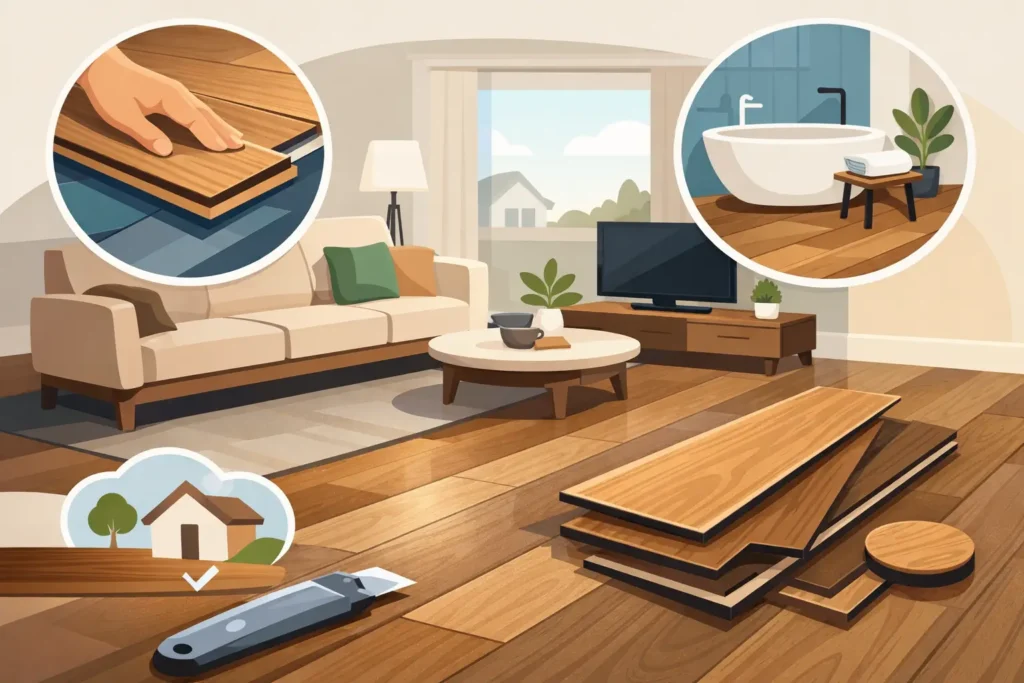
A floor can make a renovated kitchen feel polished, give a busy family room a more relaxed rhythm, or turn an outdated rental unit into a space people remember. This luxury vinyl plank flooring review looks beyond showroom samples to answer the question homeowners actually have: will LVP look beautiful and hold up in the way your household lives?
Luxury vinyl plank, often called LVP, has become a leading choice for Southern California renovations because it delivers the warm look of wood with practical performance in rooms where real hardwood may require more caution. It is not the right answer for every home or every design goal, but when selected and installed well, it can offer an impressive balance of style, comfort, and long-term value.
What Luxury Vinyl Plank Really Offers
LVP is made in layered planks designed to replicate hardwood. The top layer provides visual texture and protection, while the core creates stability and water resistance. Modern collections can capture wood grain, knots, color variation, and wider-plank proportions with surprising realism, especially when viewed across a complete room rather than in a single sample.
For homeowners planning a kitchen remodel, bathroom update, garage conversion, or whole-home refresh, its biggest appeal is flexibility. A single floor can often continue from the living area into the kitchen, hallway, bedrooms, and laundry room. That continuity makes the home feel larger and more intentional.
The material is also softer and quieter underfoot than ceramic tile. For families with young children, pets, or active households, that difference is felt every day. It does not have the same natural character as genuine hardwood, but it avoids many of hardwood’s concerns around spills, scratches, and changing humidity.
Luxury Vinyl Plank Flooring Review: The Real Benefits
The strongest LVP products earn their reputation through everyday resilience. A quality plank resists water exposure, handles routine cleaning without special products, and stands up well to the dropped toys, pet claws, chair movement, and foot traffic that come with a lived-in home.
Water resistance is particularly valuable in Southern California kitchens and bathrooms. A leaking dishwasher or a wet towel left on the floor does not automatically mean a ruined installation. Most LVP is marketed as waterproof, meaning the plank itself will not absorb water. That does not mean every part of the floor system is immune to moisture. Water can still reach the subfloor through perimeter gaps, floor vents, or poorly sealed transitions, so prompt cleanup remains the smart approach.
Design range is another major advantage. Homeowners can choose clean oak looks for a modern coastal interior, rich walnut tones for a more traditional setting, or pale natural wood visuals that brighten a condo or ADU. Matte finishes and embossed textures tend to look more convincing than high-gloss, overly uniform options. Wider planks can create a more upscale effect, but the room’s proportions and the direction of natural light should guide the final choice.
LVP can also be a practical value decision. Its installed cost is often lower than premium hardwood, and its maintenance demands are lighter. That leaves more of the renovation budget available for cabinetry, lighting, custom tile, or the details that make a completed space feel truly personal.
Where LVP Has Limitations
No flooring material is perfect, and a credible review should be clear about the trade-offs. Luxury vinyl plank can dent under concentrated weight. Heavy furniture with narrow legs, appliances moved without protection, or a sharp impact can damage the surface or compress the core. Felt pads, protective furniture cups, and professional moving practices help preserve the floor.
It can also fade with prolonged, intense sun exposure. Southern California homes often have abundant natural light, which is a design advantage but requires planning. Quality window coverings and products with strong UV protection are worthwhile in rooms with large sliding doors or direct afternoon sun.
If your goal is a floor that can be refinished decades later, genuine hardwood remains the better fit. LVP cannot be sanded and refinished. When it is significantly damaged or when its style has run its course, individual planks may be replaced if matching material is available, or the floor may need to be replaced altogether.
Finally, not all LVP looks premium. Lower-priced products may have repetitive patterns, thin wear layers, shallow texture, or edges that reveal the material’s synthetic character. Flooring is a highly visible design surface. Choosing based on the lowest price alone can undermine the result of an otherwise thoughtful remodel.
How to Judge Quality Before You Buy
Start with the wear layer, measured in mils. For bedrooms and low-traffic spaces, a 12-mil wear layer may be adequate. For active households, kitchens, hallways, living rooms, and rental properties, 20 mil is usually a more confident target. A thicker wear layer generally improves resistance to scratching and surface wear, though it should be considered alongside the product’s warranty, finish quality, and overall construction.
Next, look at the core. Rigid core options, commonly identified as SPC or WPC, offer different benefits. SPC has a denser stone-polymer core that feels firm and handles temperature changes well. WPC has a wood-polymer core that can feel slightly warmer and softer underfoot. The better option depends on the room, the condition of the subfloor, and the experience you want when walking on it.
Take full-size samples home whenever possible. Look at them in morning and evening light, beside your cabinets, wall color, and furniture. Place a few planks together so you can see whether the pattern repeats too frequently. A beautiful display board is helpful, but it cannot show how the floor will read across 500 or 1,500 square feet.
Ask about the product’s attached pad, underlayment requirements, and installation method. Click-lock floating floors are common and can be efficient to install, while glue-down LVP is often favored for commercial applications, high-traffic areas, and certain rental properties. Each approach has subfloor and preparation requirements that should be evaluated before materials are ordered.
Installation Is Where Performance Is Won or Lost
The plank itself is only part of the investment. Subfloor preparation has a direct effect on how the finished floor looks, feels, and lasts. LVP can hide minor visual imperfections, but it does not correct an uneven subfloor. Dips, humps, cracks, moisture concerns, and damaged areas should be addressed before installation.
A floating floor needs the proper expansion space around walls, cabinetry, and fixed objects. Without it, the planks may bind or buckle as temperatures shift. Transitions at doorways and connections to tile or carpet also deserve careful planning, particularly in a whole-home remodel where clean sightlines matter.
Professional installation is especially valuable when flooring runs through several rooms, meets new cabinetry, or is part of a larger kitchen, bathroom, or ADU project. The goal is not simply to lay planks straight. It is to create balanced cuts, thoughtful transitions, and a finished surface that supports the entire design vision.
Is LVP Right for Every Room?
Luxury vinyl plank performs especially well in living rooms, bedrooms, kitchens, dining areas, hallways, laundry rooms, and many bathrooms. It is a strong candidate for homes that need one cohesive, low-maintenance floor without sacrificing a warm, wood-inspired look.
For full bathrooms, it works best when the perimeter and transitions are carefully handled and spills are not left sitting for long periods. In a primary bathroom where a homeowner wants a more elevated, spa-like finish, large-format porcelain tile may still be the preferred choice. Tile brings a cooler feel, greater permanence, and a level of luxury that certain designs call for.
In homes with major sun exposure, radiant heat, or potentially damp concrete slabs, product selection and site conditions matter even more. A flooring professional can help determine whether LVP, engineered hardwood, tile, or another material is the better investment for that specific space.
The Bottom Line for Southern California Homes
LVP is at its best when it is chosen as a deliberate design material, not as a shortcut. Select a realistic visual, a durable wear layer, and a product suited to your home’s conditions. Then give installation the same attention you would give cabinetry, countertops, or tile.
For homeowners who want wood-inspired style with easier upkeep, luxury vinyl plank can deliver affordable luxury underfoot. During a design-and-build remodel, Creative Remodeling 1 can help align flooring choices with the way you use your space, the finishes you love, and the long-term value you want from your home. The right floor should do more than survive daily life – it should make coming home feel better every time you walk through the door.